
In printed fabric cutting, the biggest problem is not laser power—it is stopping. Each time a cutting cycle ends, the machine must stop, load material, align the pattern, and restart. The time lost to these steps can exceed the actual cutting time. The main benefit of an automatic fabric laser cutting machine with panoramic vision is continuous movement through the cutting process.
But the definition of “automatic” varies widely among suppliers. Some machines merely add a conveyor belt. Some have a vision system but the algorithm can’t keep up. Some have a cutting module that doesn’t match the feeding speed. For roll-fed production, see the automatic fabric laser cutting machine with auto feeding. Making the wrong choice can leave you with a semi-automatic machine, limited efficiency gains and a slower return on investment.
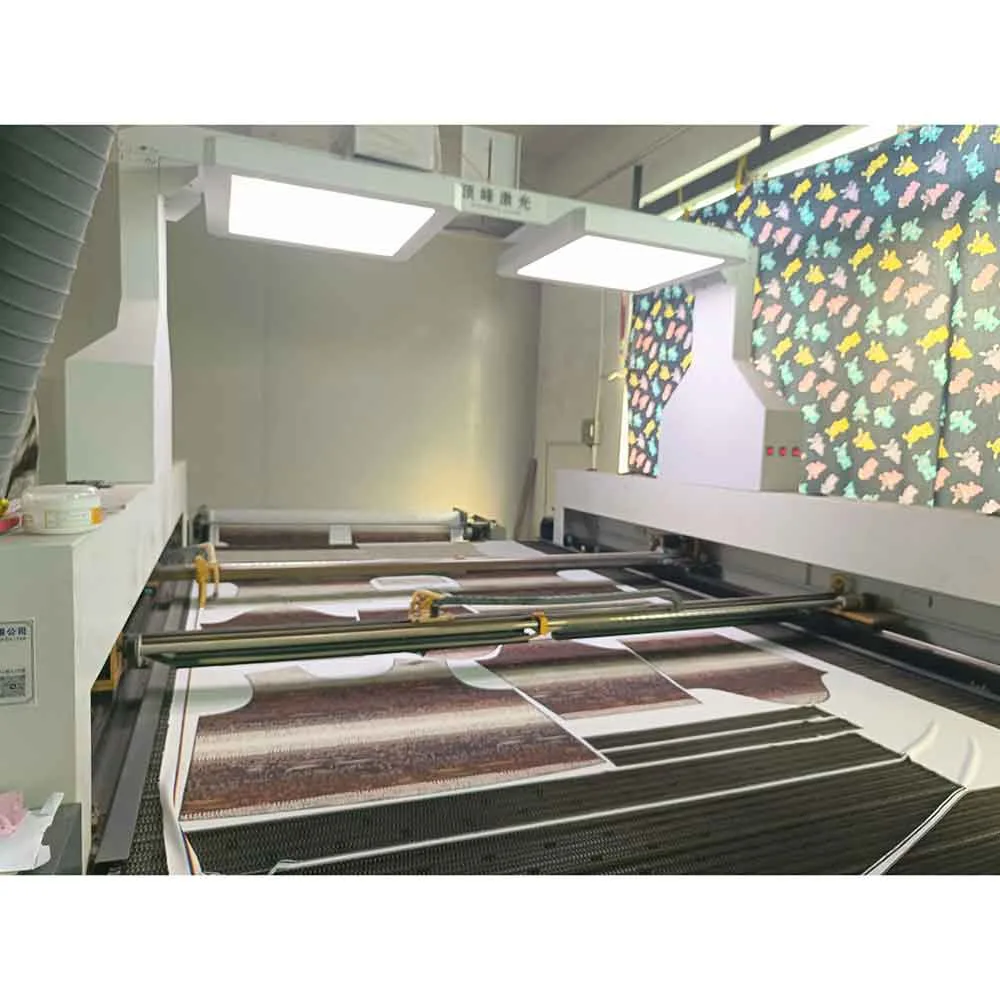
Where Is the Bottleneck? First, Identify Which Step Is Slow
The automatic cutting of printed fabric breaks down into four steps: feeding, recognition, cutting, and collection. Each step has its own speed limit. The output of the whole line is limited by its slowest step.
Feeding. Fabric unwinds from the roll, passes through tension control, and enters the cutting area. If feeding speed is unstable, the fabric drifts or wrinkles, affecting both vision recognition and cutting. The core specification of the feeding mechanism is closed-loop tension control precision—not just a speed number.
Recognition. Printed fabric requires a CCD camera to identify pattern contours or registration marks and calculate the cutting path. Recognition time depends on camera resolution, field of view and software. High-end systems can complete recognition of the cutting area within a few seconds. For a practical guide, see how to cut printed fabrics accurately.
Cutting. Cutting efficiency depends on the movement speed, acceleration and power of the laser head. Galvo heads are generally faster than traditional gantry systems and are well suited to thin materials and high-speed perforation.
Collection. Cut pieces must be removed from the cutting area and moved to collection or sorting. If this step relies on manual labor, it can slow down even the most automated upstream process.
Key check: If your current machine is semi-automatic—with automatic feeding but manual alignment, or automatic vision but manual collection—the manual step is likely the bottleneck.
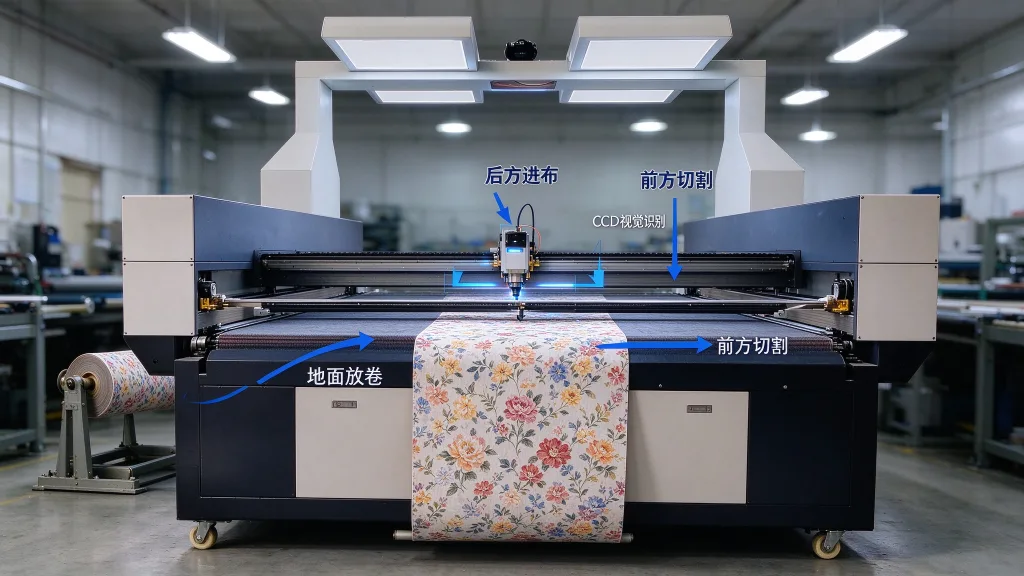
Vision Positioning System: The Core Component for Continuous Cutting
Printed fabric has a unique challenge: pattern positions are not fixed. Fabric shrinks, stretches, or distorts during printing and heat treatment. Actual pattern positions deviate from the original layout coordinates.
Without a vision system, an automatic cutter can only follow fixed coordinates, effectively cutting blind. Misaligned pieces go straight to scrap. With a CCD vision laser cutter, the machine first photographs the fabric, identifies pattern contours or registration marks, and then corrects the cutting path.
Three specifications to evaluate:
Recognition speed. A top-tier system can complete full-area recognition within seconds without dragging down the continuous production cycle. If recognition takes over ten seconds, the advantage of continuous cutting is eaten away.
Deformation compensation. Fabric is not rigid. Local stretching or shrinking happens constantly. Basic vision only compensates for translation and rotation. High-end software supports non-linear deformation correction with region-by-region precise matching.
Mark recognition vs. contour recognition. Mark recognition suits fabric with pre-set registration points—high precision, fast speed. Contour recognition doesn’t need preset marks; it directly identifies the outer contour of the printed pattern, ideal for printed fabric without registration marks. The best systems support both modes, so you can switch according to the order.
Cutting Module: Galvo or Gantry
Automatic fabric laser cutting machines can be configured with gantry or galvo cutting heads.
Gantry systems use a moving laser head mounted on a beam. They are suitable for thicker materials and larger cutting areas. Speed is lower, but the power ceiling is higher.
Galvo heads deflect the laser beam through high-speed mirrors. The head remains stationary while the beam moves rapidly across the work area. High-end galvo systems can cut quickly, making them suitable for thin materials and perforation. Actual speed depends on material, head configuration and cutting path. A key advantage of galvo is on-the-fly processing: the laser cuts while the fabric moves continuously on the conveyor.
For continuous cutting of printed fabric, a galvo head is often the better choice, while the machine can also support an interchangeable gantry head for thicker or multi-layer materials. The fabric continues moving while the galvo head follows the cutting path, coordinated with real-time vision correction.
Interchangeable heads: You can change the cutting head to suit the material and process. Galvo is suitable for thin to medium-thickness printed fabric, while a gantry head is normally used for thicker or multi-layer cutting. Confirm the available head options and changeover procedure with the supplier.
Feeding and Collection: Ensuring Continuity
Tension control is critical to the feeding system. If tension is unstable during cutting, the fabric drifts, wrinkles, or stretches, reducing cutting accuracy. A closed-loop tension control system helps keep the fabric flat and evenly fed through the line.
Matching the feeder to the rest of the line is critical. Feeding speed must match vision and cutting speed. If the feeder runs too fast, vision cannot keep up. If it runs too slowly, the cutting head sits idle. Ask the supplier for measured whole-line coordination data, not just the feeder speed specification.
Collection and sorting: On this machine, feeding, vision recognition and laser cutting are automatic; collection and sorting are normally manual. If automatic collection or sorting is required, confirm the optional configuration and whole-line layout with the supplier.
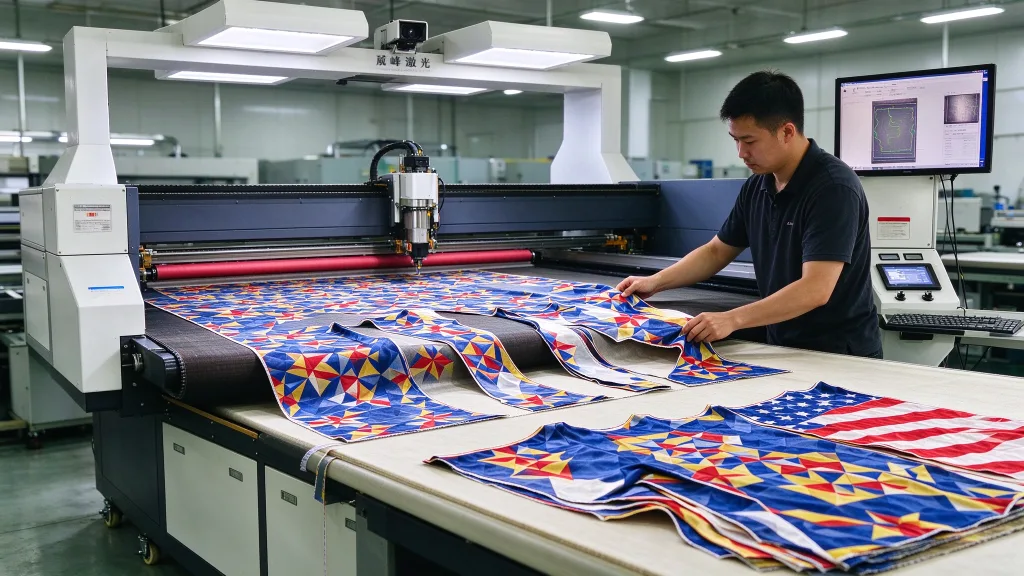
Configuration by Order Structure
Daily cutting volume under 50 sqm, mainly sampling and small-batch custom work: Choose a static table model with CCD vision. Feeding can be manually assisted. Focus on vision positioning accuracy and cut quality.
Daily cutting volume 50–200 sqm, mainly batch cutting: Choose a conveyor-type automatic model with CCD vision and automatic feeding. A galvo cutting head significantly boosts thin-material cutting speed. This tier suits small to medium print shops and garment factories.
Daily cutting volume over 200 sqm, continuous production: Choose an industrial-grade automatic model with panoramic vision, automatic feeding and a high-speed cutting head. Collection and sorting can remain manual or be configured optionally. For high-volume production, see the high-speed fabric laser cutting machine. Focus on whole-line cycle matching and continuous operation stability.
Frequently Asked Questions
What does “automatic” include on this machine?
On this machine, automation covers automatic feeding, automatic panoramic vision recognition and automatic laser cutting. Collection and sorting remain manual unless an optional system is added. When selecting, ask exactly which steps are automatic—do not rely on marketing language.
How much does a CCD vision system improve cutting efficiency for printed fabric?
The vision system does not directly increase cutting speed, but it removes manual alignment time. Manual alignment can take anywhere from a few seconds to more than ten seconds per piece. A vision system can complete full-area recognition and generate the cutting path within a few seconds, depending on camera and software. For high-volume continuous cutting, this time savings is significant.
How thick a fabric can a galvo cutting module handle?
Galvo suits single-layer thin and medium-thickness fabrics. Typical applications include sportswear fabric, lace, chiffon, and flag material. Multi-layer stacking or thick fabrics (such as heavy denim) usually require gantry or hybrid solutions. Actual thickness depends on laser power and fabric type. Always test with your actual fabric.
What is the typical ROI period for an automatic cutter?
It depends on your current efficiency and labor costs. In suitable conditions, one automatic line can replace four to five manual operators, depending on order mix, shifts and workflow. Calculate ROI using your actual output, labor cost and product value.
Conclusion: Improving efficiency in automatic printed fabric cutting is not about laser power alone. It depends on feeding continuity, vision accuracy and whole-line coordination. Start by identifying the bottleneck, then match the vision system and cutting head to your production. Bring your printed fabric to a supplier and run a complete continuous cutting cycle. Contact Dingfeng for a sample test. Check that feeding, recognition, cutting and collection work together smoothly, then confirm the result with your own fabric before making a decision.