
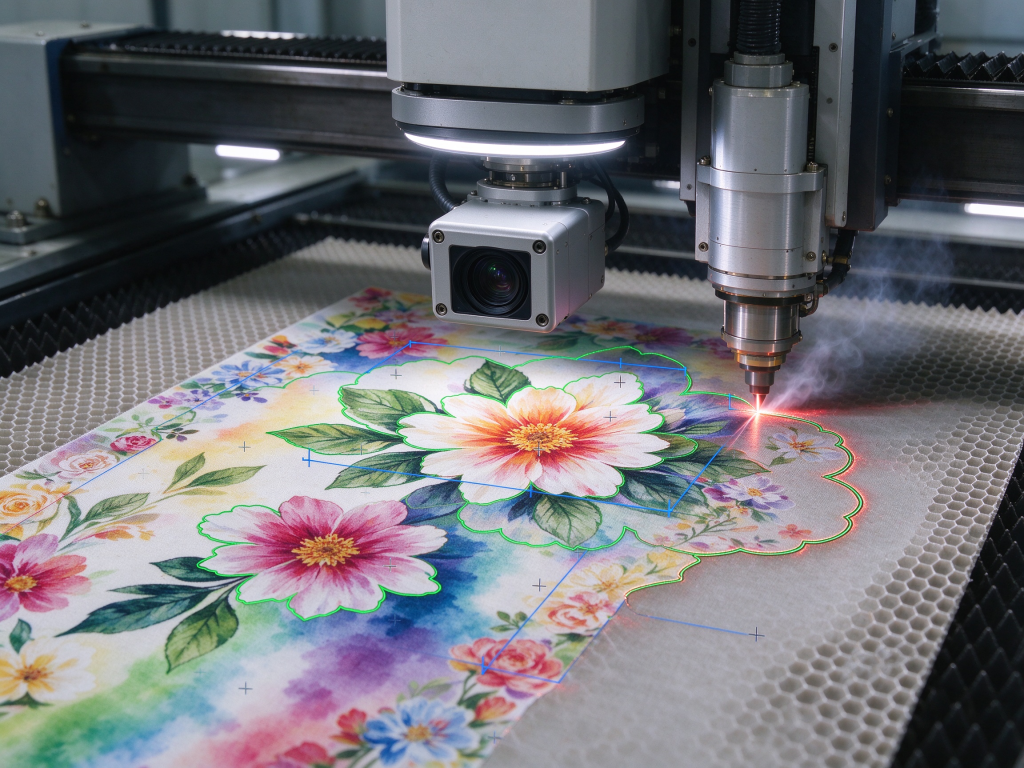
Lace fabric is one of the most difficult textiles to cut. Fine patterns, dense hollow-outs, and delicate fibers make traditional die punching a nightmare—edges fray, fibers get pulled, and the lace pattern deforms under mechanical stress. Manual cutting is even worse. A complex hollow lace edge takes a full day to cut by hand, and quality is never consistent.
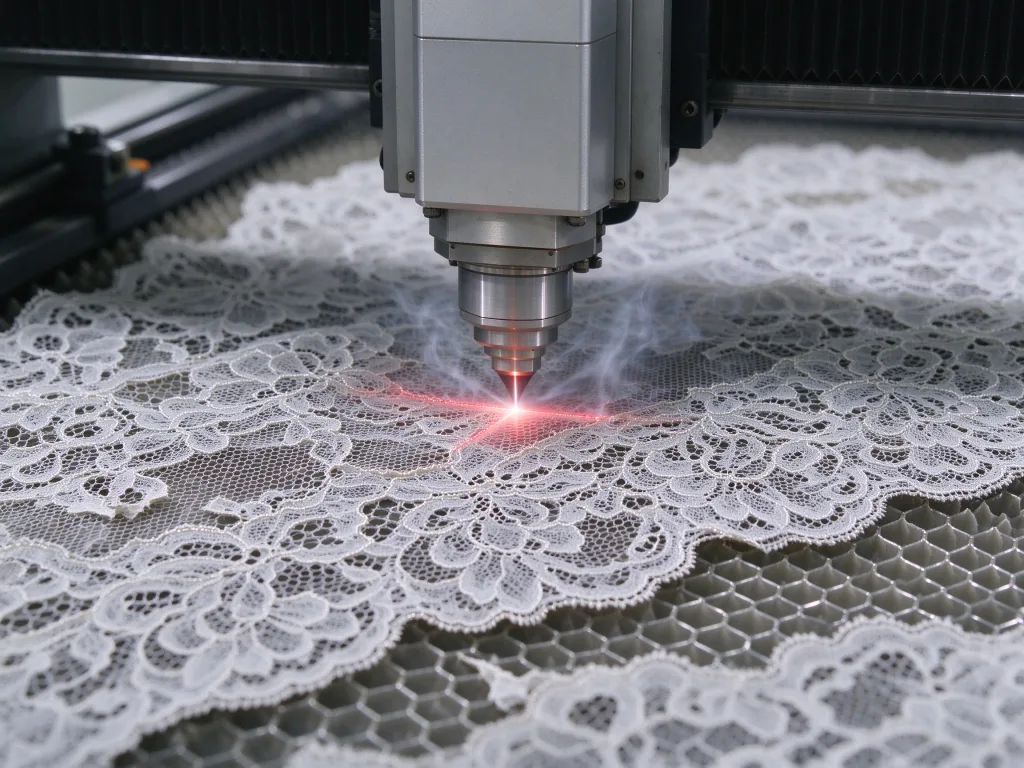
CO2 laser cutting is the proven solution. The laser beam cuts without contact, no mechanical squeezing, and typically achieves cutting precision around ±0.1–0.2mm on stable lace fabrics. It handles the complex curves and hollow details of lace edging perfectly. More importantly, for synthetic lace like polyester and nylon, the laser’s heat instantly melts the cut edge fibers, which re-solidify into a smooth sealed edge. This eliminates fraying at the source—no serging, no overlocking, no secondary processing.
But lace fabric is not just one material. Polyester lace, nylon lace, cotton lace, and elastic lace all respond differently to the laser. Fiber composition determines power and speed settings. Choose the wrong configuration, and you either don’t cut through, burn the edge, or leave yellow scorch marks. Let’s break down the selection logic across four dimensions: fabric type, core configuration, power selection, and vision positioning.
First, Know Your Lace Fiber
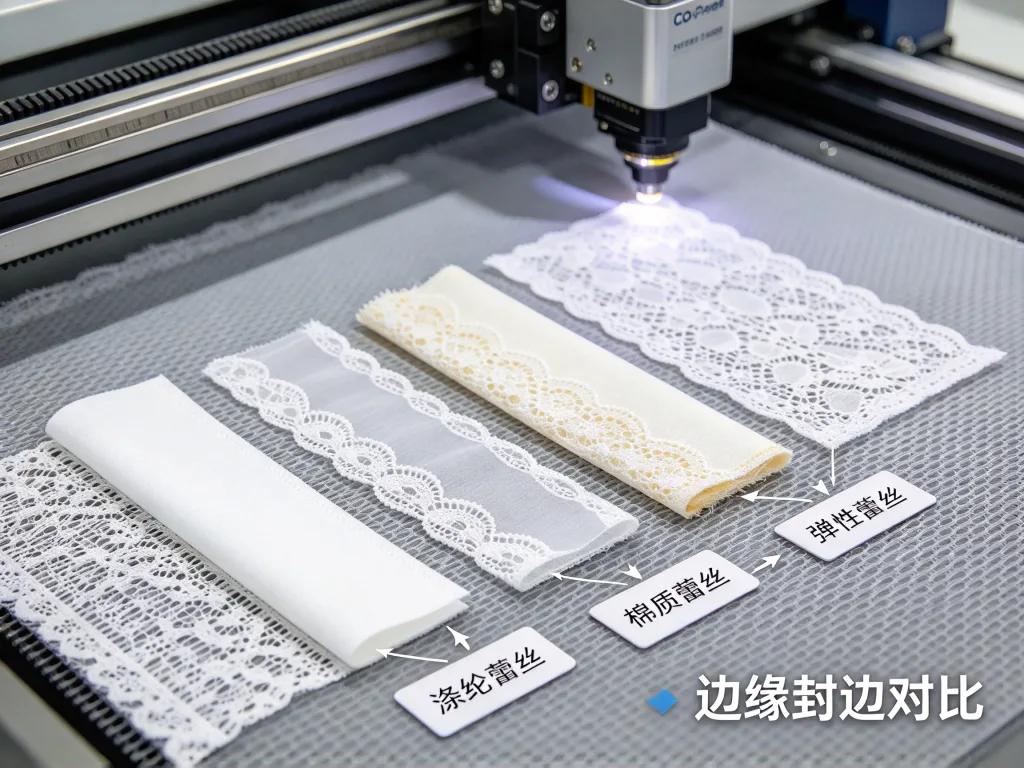
The fiber composition of your lace is the first decision point. Different fibers absorb CO2 laser energy at different rates, which directly determines power settings and cut quality.
Polyester lace is the ideal material for laser cutting. Polyester is a thermoplastic fiber—the laser melts the edge, which re-solidifies into a smooth sealed edge with no fraying or loose threads. Power range: 80W to 130W, depending on lace density and thickness.
Nylon lace also cuts well with laser. Nylon responds well to the laser, producing smooth edges while maintaining pattern precision. Nylon lace is widely used in lingerie and stretch lace fabrics. Power range: 80W to 120W.
Cotton lace requires caution. Cotton is a natural fiber with no melting point. The laser won’t seal the edge—it may char and yellow instead. Cutting cotton lace requires lower power, higher speed, and air assist to reduce carbonization. Power range: generally below 80W, depending on lace weight and settings. If heat damage remains a problem, an oscillating knife cutting machine is a non-laser alternative.
Elastic lace (lace containing spandex) needs special attention to heat effect. Laser cutting avoids the stretching and deformation caused by mechanical cutting, but excessive power can damage the elastic fibers. Power range: 80W to 100W, with proper feed tension control.
Power Selection: The Logic Behind 80W to 150W
CO2 laser machines for lace cutting typically range from 80W to 150W. How to choose within this range depends on two factors: lace fiber type and daily production volume.
For most lace fabrics, 100W is a safe starting point. Based on general industry experience, most fabrics achieve stable cutting results at 100W laser power. If your lace is primarily polyester and nylon with medium density, a 100W CO2 RF tube laser is more than sufficient. For continuous production, the high-speed fabric laser cutting machine is the better platform. RF tubes produce a finer beam than glass tubes, which matters for delicate lace patterns.
If you mainly cut high-density embroidered lace or bridal lace, or lace with thicker fibers, consider 130W to 150W. Higher power lets you cut faster while ensuring complete penetration, but be careful—too much power can cause edge yellowing or an enlarged heat-affected zone.
If your daily volume exceeds 200 square meters of lace, choose a 150W+ industrial model with dual-head asynchronous cutting. Two laser heads move independently, improving efficiency by up to 50%, depending on pattern layout and cutting path compared to single-head machines.
More power is not always better. For thin lace and elastic lace, excessive power actually burns the edge. A 100W machine running at 40% to 60% power on thin lace gives you more control than a 150W machine running at full power.
Vision Positioning: The “Eyes” of Lace Cutting
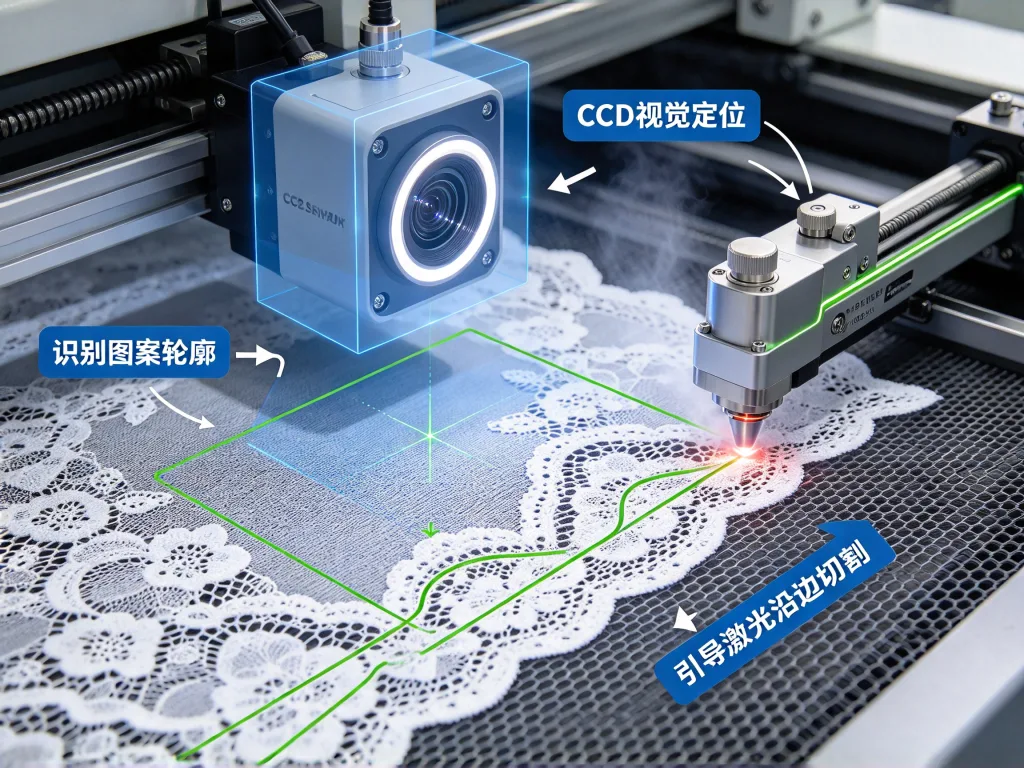
Lace fabric has a unique challenge: patterns are irregular. Scalloped edges, hollow patterns, embroidered motifs—each section has a different shape and position. If you use a fixed cutting path, the lace pattern will misalign.
This is where vision positioning systems come in. A camera captures the lace fabric before cutting, identifies the actual contour of the lace pattern, and dynamically adjusts the laser cutting path to follow the pattern edge precisely. For patterned lace—printed lace, embroidered lace, jacquard lace—vision positioning is practically essential. See the panoramic vision laser cutting machine and our guide to cutting printed fabrics accurately.
Vision system precision directly affects cut quality. Current mainstream systems typically achieve positioning accuracy within about ±0.1–0.2mm, depending on material, calibration and machine configuration. Combined with specialized lace edge recognition algorithms, they accurately extract the complex curves and hollow patterns of lace. If your lace products are bridal lace or lingerie lace—categories with zero tolerance for pattern misalignment—you cannot skip the vision system.
Additionally, for elastic lace and sheer lace, feed tension control is critical. Fabric cut under tension will shrink back after cutting, causing dimensional deviation. A feed mechanism with closed-loop tension control effectively reduces this problem.
Feeding Method: Roll-to-Roll or Conveyor Belt
Lace fabric typically arrives in rolls, so the feeding method directly affects production efficiency and continuity.
Roll-to-roll feeding processes lace directly from the textile roll, supporting continuous production. For continuous roll production, the auto-feeding laser cutting machine can maintain stable tension and uninterrupted feeding. This is ideal for lace production lines and large garment factories. It requires stable feed tension control to keep the lace from drifting or stretching during cutting.
Conveyor belt feeding uses a belt-driven worktable to transport lace fabric through the cutting area. This configuration suits embroidered lace pieces and multi-layer lace pieces that need stable positioning.
If your lace orders are primarily large-volume rolls, choose roll-to-roll. If your orders are primarily cut pieces and patches, choose conveyor belt. If your lace needs to be cut and then automatically rewound, add an auto take-up system.
Budget Allocation: Configuration Differences by Tier
Lace laser cutting machine prices vary widely. Entry-level static worktable models (1300×900mm bed size) cost approximately $4,500 to $8,500, suitable for small-batch lace piece processing. Mid-range conveyor models with auto-feeding and CCD camera cost approximately $15,000 to $28,000, suitable for garment factory batch lace cutting. High-end vision-integrated dual-head systems with RF metal tube lasers and high-resolution CCD vision can exceed $55,000, suitable for high-precision, high-volume lace production. Prices are indicative only and vary by configuration, voltage, shipping, duties and destination.
For lower-volume lace work, a standard CO2 fabric laser cutter is often sufficient. For larger production, prioritize spending on three things: laser type (RF tube over glass tube), vision positioning system (essential for patterned lace), and feeding system (roll-to-roll over static table). Power can be selected based on your lace type and volume needs—no need to chase the highest number.
Frequently Asked Questions
Will CO2 laser cutting burn lace?
Polyester and nylon lace: no. The laser instantly melts and re-solidifies the edge into a smooth seal—this is the core advantage of laser cutting for lace. Cotton lace requires attention because cotton fibers have no melting point. Improper laser settings can cause edge charring and yellowing. Cutting cotton lace requires lower power, higher speed, and air assist.
Does laser-cut lace need secondary processing?
For synthetic lace (polyester, nylon, elastic lace): no. Laser cutting seals the edge simultaneously, so the lace goes straight to sewing—no serging or overlocking needed. For cotton lace, minor edge cleanup may be required, but it’s far better than the fraying caused by traditional die cutting.
How much does a lace laser cutting machine cost?
Entry-level static table models: $4,500 to $8,500, suitable for small-batch lace pieces. Mid-range conveyor models with CCD vision and auto-feeding: $15,000 to $28,000, suitable for garment factory batch production. High-end dual-head vision-integrated systems: over $55,000, for high-precision, high-volume applications. Price differences come mainly from laser type (glass vs RF tube), vision system configuration, and feeding method.
Does a lace laser cutter need a fume extraction system?
Yes. Laser cutting lace produces smoke and odor, especially when cutting synthetic lace. The machine must be equipped with a fume extraction unit or a central dust extraction interface to keep the working environment clean and meet environmental regulations.
Conclusion
The core logic for choosing a CO2 laser for lace fabric is: fiber composition determines power, pattern requirements determine the vision system, and production volume determines the feeding method. Polyester and nylon lace are the best match for laser cutting—start with 100W RF tube, add CCD vision positioning for edge-following cutting, and use roll-to-roll feeding for continuous production. Cotton lace requires lower power and air assist. Before buying, bring your lace fabric to a supplier for an on-site sample test. Check the edge sealing, cutting precision, and speed against your product requirements. Contact our team to arrange a lace cutting sample test. Let the results speak—no matter how good the spec sheet looks, nothing beats seeing the cut lace edge with your own eyes.