
If you work in leather goods, footwear, or denim apparel, you have probably seen this machine before: a piece of leather goes down, the laser head buzzes for a few seconds, and a row of breathable holes is punched—with no blackened edges. Denim is even more impressive: a few seconds to burn a cat-whisker or worn-out effect that used to take dozens of manual passes. That is a CO2 galvo laser marking machine.
But when many people buy one, the first question they ask is “How many watts?” That is the wrong question. Wattage only determines speed and depth. It does not determine whether the machine can mark your material at all. What really determines that is whether the laser wavelength matches the material.
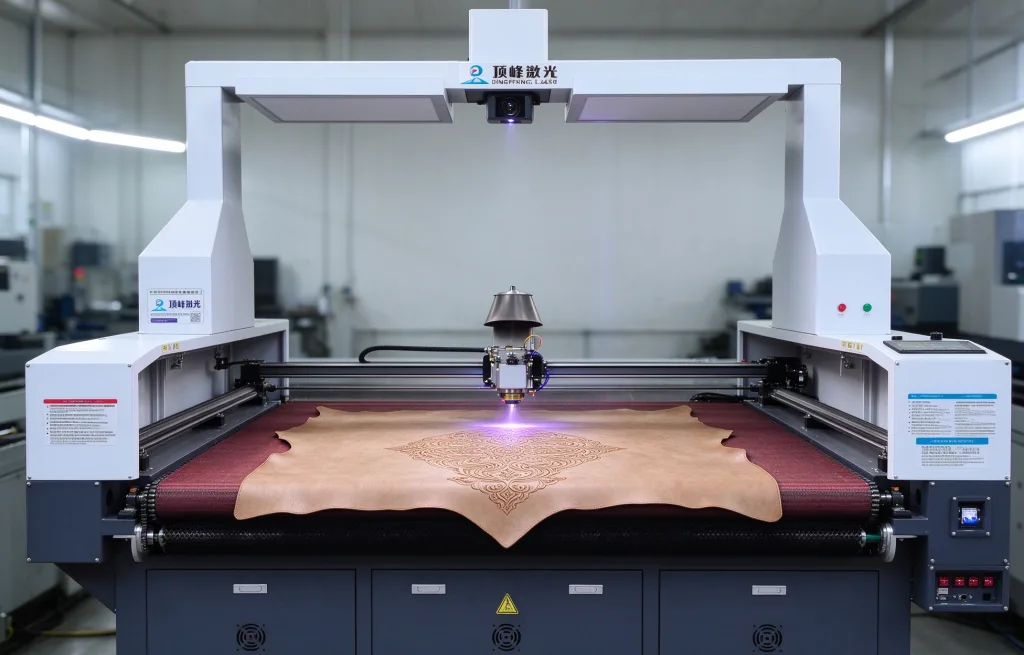
Galvo vs. Gantry—What’s the Real Difference?
Laser marking machines come in two structural types. One is gantry-style, where the laser head moves along a beam like a CNC router. The other is galvo-style, where the laser head stays fixed and two small mirrors inside move at high speed to redirect the beam.
These two mirrors are mounted on galvo motors. When powered, the mirrors deflect at high speed, changing the reflection angle of the laser. One mirror handles the X-axis, the other handles the Y-axis. Together with a field lens, the laser is focused onto the working plane. There is no mechanical movement in the process—a full pattern can be drawn in a few hundred milliseconds.
Speed is the galvo’s biggest advantage. Galvo machines can mark at 1000 to 7000 mm/s, while gantry machines typically run at only 50 to 300 mm/s. For jobs like leather hollowing, denim burnout, and film cutting—where the laser needs to move fast and frequently—a gantry machine simply cannot keep up. A galvo machine is the right choice.
Why Can’t CO2 Lasers Mark Metal?
CO2 lasers operate at a wavelength of 10.6 microns, in the far infrared. At this wavelength, non-metal materials absorb energy extremely well. Leather, fabric, wood, paper, acrylic, film—their molecular structures naturally absorb this wavelength.
Metal is the opposite. It reflects almost all energy at 10.6 microns. The beam hits the surface, and most of it bounces off. It cannot penetrate. That is why CO2 laser marking machines are not suitable for metal. It is not a matter of machine quality—it is physics.
Your Three Core Applications—What to Watch For
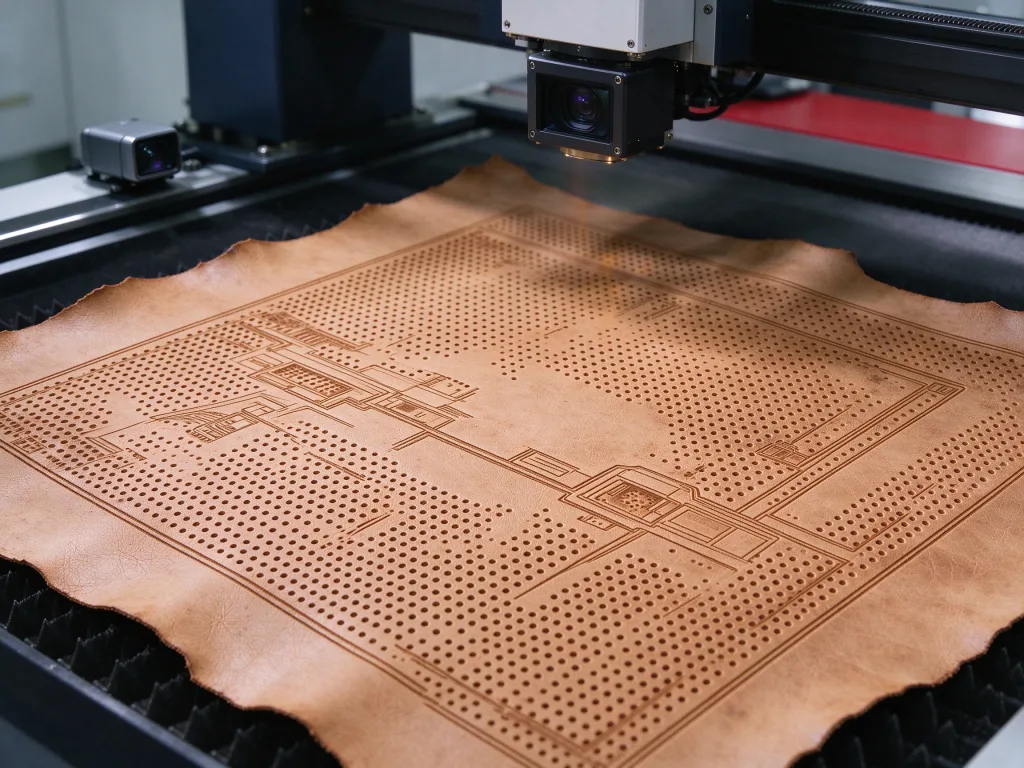
Leather Perforation and Engraving
Traditional die punching pulls and tears leather fibers, causing edge cracking and curling. Mechanical drilling is even more limited—the hole size is fixed, and irregular shapes or dense micro-perforations are impossible.
Laser is different. It vaporizes material with instant heat, with no mechanical squeezing. The cut edge is slightly sealed, preventing fraying. These factors make laser ideal for leather perforation and engraving.
In practice, use low power and high speed for soft leather to reduce heat deformation. For dense micro-perforations, use pulsed firing to prevent surrounding leather from overheating. For suede, lower the heat output to avoid burning away the surface texture.
Both 100W and 150W machines can handle leather. On a 100W machine, dial the power percentage down to 30%–50% and it is more than enough. A 150W machine can also be dialed down, but if you only work with leather, 100W offers better value.
Film Cutting
PET, PMMA, and PI films are widely used in phones, displays, and electronic components. The key to CO2 laser film cutting is controlling the heat-affected zone. Cut too fast and it does not separate. Cut too slow and the edge melts and chars.
For 100W film cutting, you can run higher speed and set power at 40%–60%. Use gas assist to minimize charring. A 150W machine cuts faster, making it suitable for high-volume film production. Make sure the film is flat before cutting—if the focus shifts, cut quality suffers.
Denim Burnout
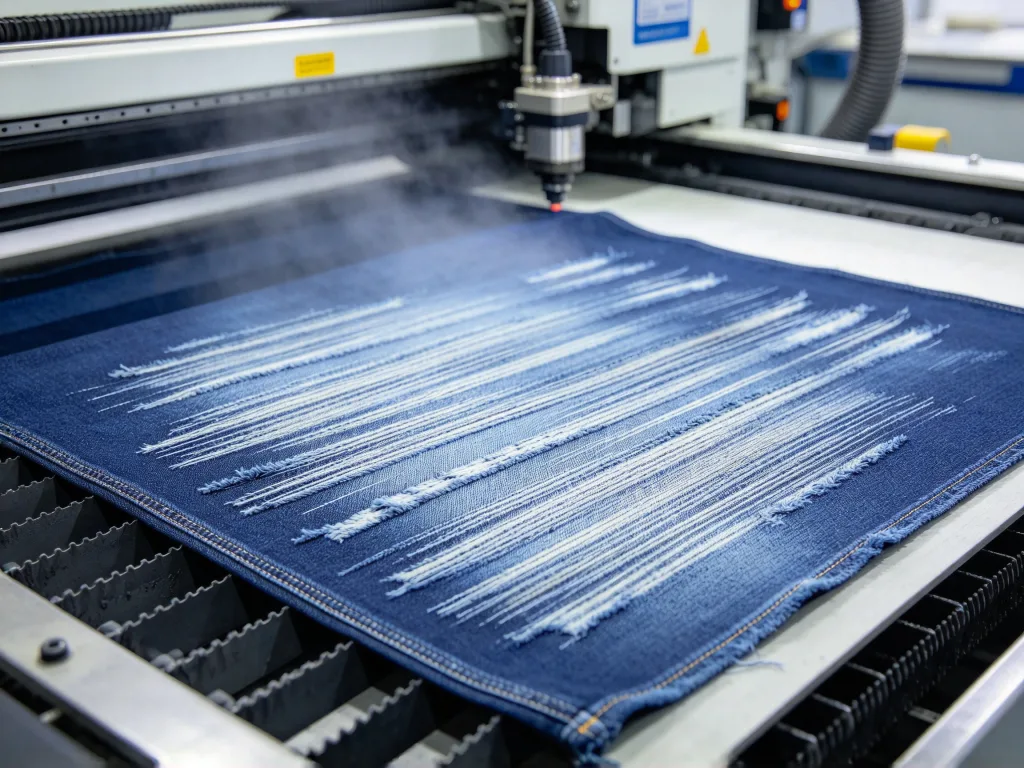
Denim burnout is the most established CO2 laser application in apparel. A high-energy beam hits the denim surface, burning away yarns and vaporizing dye to create cat-whisker, monkey-wash, distressed, and worn effects—whatever you need.
Both 100W and 150W can do burnout. The difference is efficiency. A 150W machine runs faster. For the same pattern, 150W can be 30%–50% faster than 100W. If you handle large denim orders, 150W is more cost-effective. If volume is moderate, 100W is sufficient.
But be careful: too much power burns through the fabric or leaves a black, hardened edge. Too little power leaves the color insufficiently faded. Speed and power must be matched and adjusted together.
100W vs. 150W—How to Choose?
Start with what you mainly do.
If your work is mostly leather perforation, engraving, film cutting, and denim burnout—and order volume is moderate—100W is completely sufficient. A 100W machine costs less and pays for itself faster. You simply dial down the power percentage in the software to adapt to different materials.
If you take on a lot of denim burnout orders, or need faster film cutting, or want to handle thicker materials down the road, go with 150W. A 150W machine has stronger cutting capability and higher speed, but it also costs more.
One more factor: the field lens. Regardless of 100W or 150W, the field lens determines the marking area. For 100mm × 100mm leather pieces, an F=150mm field lens is sufficient. For 200mm × 200mm, you need an F=275mm lens. Field lenses are optional. When buying, ask what the standard configuration includes and how much an extra lens costs.
Three Things You Must Do Before Buying
First, bring your material for an on-site sample test. Leather hardness varies. Film thickness varies. Denim weight varies. Results differ significantly. No matter what the salesperson says, seeing it with your own eyes is better. Pay special attention to edge quality and speed differences between 100W and 150W.
Second, run the machine continuously for two hours. Watch for power degradation or galvo stuttering. CO2 laser tubes are rated for over 20,000 hours, but poor heat dissipation shortens that dramatically.
Third, specify core component brands in the contract. The laser tube, galvo head, and field lens—all must be written in. For the same budget, spending on a good galvo and a good laser tube is far wiser than simply piling on wattage.
Frequently Asked Questions
Is there a difference between 100W and 150W for leather?
Not much. Leather does not require full power. A 100W machine dialed down and a 150W machine dialed down produce similar results. The difference is efficiency. 150W runs faster, but if your orders are not urgent, 100W is enough.
How thick can a 150W machine cut?
A 150W CO2 laser can cut leather up to 5–8mm (depending on leather type and speed), and acrylic up to 10mm or more. A 100W machine cuts leather at roughly 3–5mm and acrylic at around 8mm. It depends on the material.
Do I need to buy a field lens separately?
The standard package usually includes one field lens, typically F=150mm or F=200mm. If you need a larger marking area—say 200mm × 200mm or bigger—you will need to buy an F=275mm or larger lens separately. Changing the field lens requires recalibrating the focal length. Ask about this upfront.
Conclusion
Choosing a CO2 galvo laser marking machine comes down to a simple logic: first the material, then the working area, then the power. For non-metal materials like leather, film, and denim, CO2 laser is the best fit. Both 100W and 150W can handle these jobs—the difference is efficiency and cutting capability. For high volume and speed, go 150W. For moderate volume and cost control, 100W is enough. Before buying, test with your actual material. Let the results speak.
Related products: Galvo Laser Marking Machine · Static Laser Marking Machine · Metal RF Laser Engraving Machine DF-980
Not sure whether a CO2 galvo laser fits your material? Send us your sample details and we will tell you which configuration makes sense.