
After years in equipment selection, the phrase I dread most is: “Just recommend the best cutting machine.” There is no best—only what fits. Laser burns, oscillating knife cuts. They are born for different jobs. If you force a laser to cut cotton or an oscillating knife to cut lace, that’s not the machine failing. You chose wrong.
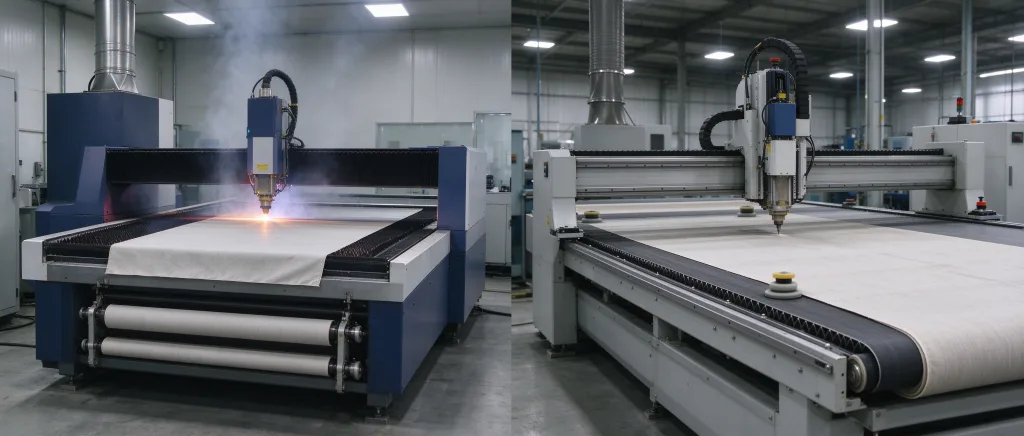
First, Understand: One Burns, One Cuts
Laser cutting works like a magnifying glass focusing sunlight, except it focuses a laser beam thousands of times stronger. It hits the fabric, creates instant high heat, and melts or vaporizes the material. So when you cut polyester, the edge seals itself—the fibers melt and re-solidify. But if you cut pure cotton, there is no melting point. You get a charred black edge, like it was burned with a cigarette.
An oscillating knife is a completely different story. It is a very sharp blade mounted on a machine, moving up and down thousands of times per minute, as fast as a sewing machine needle. It generates no heat. It simply cuts. So when you cut cotton, linen, silk, or wool, the edge is clean—no burn marks. It can also stack fabric, vacuum-hold it, and cut through a dozen layers in one stroke. That is where it shines in bulk production.
One Table to See the Core Differences
| Comparison | CO2 Laser Cutter | Oscillating Knife Cutter |
|---|---|---|
| Working Principle | Focused laser beam melts or vaporizes material | High-frequency reciprocating blade mechanically cuts fibers |
| Fabric Compatibility | Best for synthetics (polyester, nylon); natural fibers burn | Almost all flexible fabrics, especially natural fibers, coated materials, heat-sensitive fabrics |
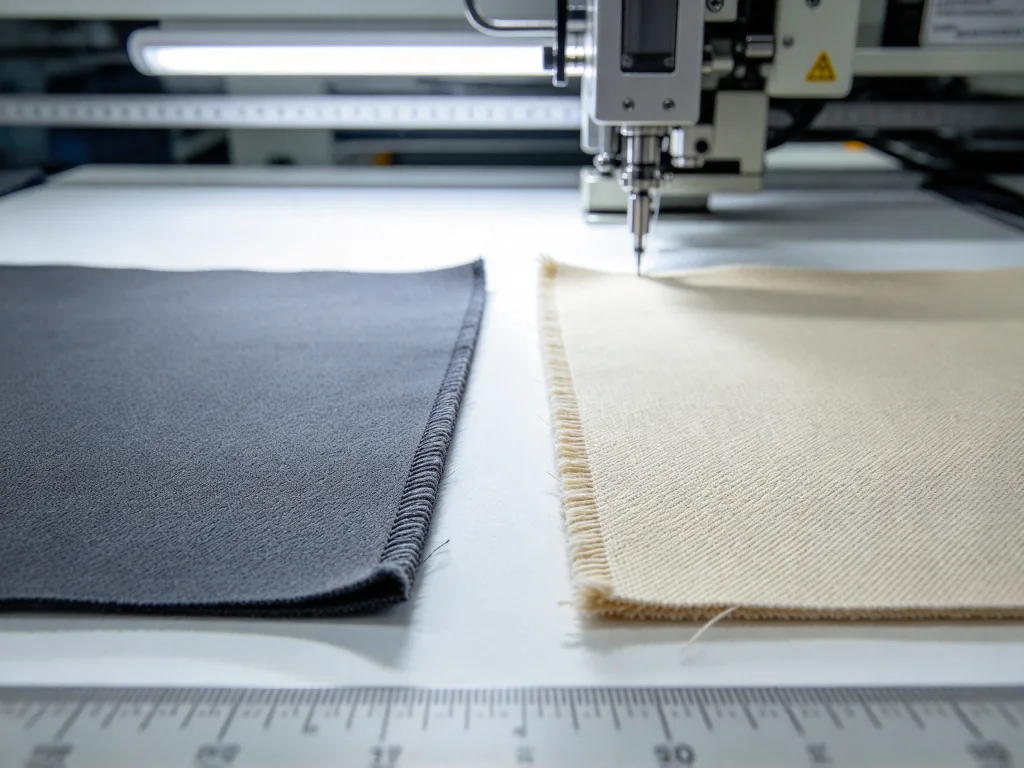
| Edge Quality | Synthetics self-seal, no fraying; natural fibers char and blacken | Clean cut, no heat effect; edges may need later serging or sealing |
| Multi-Layer Cutting | Not suitable; laser fuses edges, layers stick together | Supports stacked cutting; fabric thickness up to 8mm+ after vacuum hold |
| Fine Patterns | Strong advantage for ultra-fine lines and complex contours | Can do it, but not as precise as laser on very fine patterns |
| Throughput | Fast on single-layer thin fabric; efficient on complex contours | High output per pass on multi-layer cutting; ideal for bulk cutting |
| Environmental Requirements | Requires fume extraction; produces smoke and odor | No smoke, no odor; environmentally friendly |
| Price Range | Approx. $2,000–$11,000 (depending on power and bed size) | Approx. $1,800–$14,000 (depending on bed size and configuration) |
| Best Application | Synthetic fiber fine cutting, sampling, small-batch custom work | Natural fiber bulk multi-layer cutting, automotive interiors, home textiles |
Cutting Polyester? Laser Is Great. Cutting Cotton? Stay Away from Laser.
I have seen plenty of sportswear and swimwear factories using laser exclusively. Why? Because polyester and spandex self-seal after laser cutting. You skip the serging machine entirely. For hollow patterns and complex lace edges, an oscillating knife cannot match the precision of a CCD fabric laser cutting machine. And since it is non-contact, thin fabrics do not wrinkle. The cut is clean.
But if you take a laser to cut pure cotton T-shirt panels, expect rework. The edge is yellow and charred. Customers will call it defective. Worse, laser cannot cut multiple layers—two layers stacked together will fuse at the edge and become impossible to separate. Also, laser cutting fabric produces heavy smoke. You must install a fume extractor. A decent one costs several thousand dollars, and filters need regular replacement. Some owners skip it to save money. The workshop becomes unbearable, environmental inspectors show up, and the fines plus the machine cost more than the extractor would have.
Oscillating Knife: Cuts Almost Anything, But Don’t Expect Lace
The oscillating knife is not picky. Cotton, linen, blends, coated fabric, heat-sensitive fabric—it handles them all. Its biggest advantage is multi-layer cutting. I have seen a hotel bedding client stack a dozen layers of cotton, vacuum-hold them, and cut with an oscillating knife. The panels came out perfectly aligned, dozens of times faster than manual cutting. No burn marks—that is where it beats laser in peace of mind.
But it has weaknesses. If you want ultra-fine hollow patterns, the oscillating knife struggles. A blade has width, even a thin one. It cannot cut the needle-thin lines a laser can. Also, when cutting synthetic fibers, the edge frays and needs serging later. Blades are consumables. They wear out and need replacement—tens to hundreds of dollars each, depending on the material.
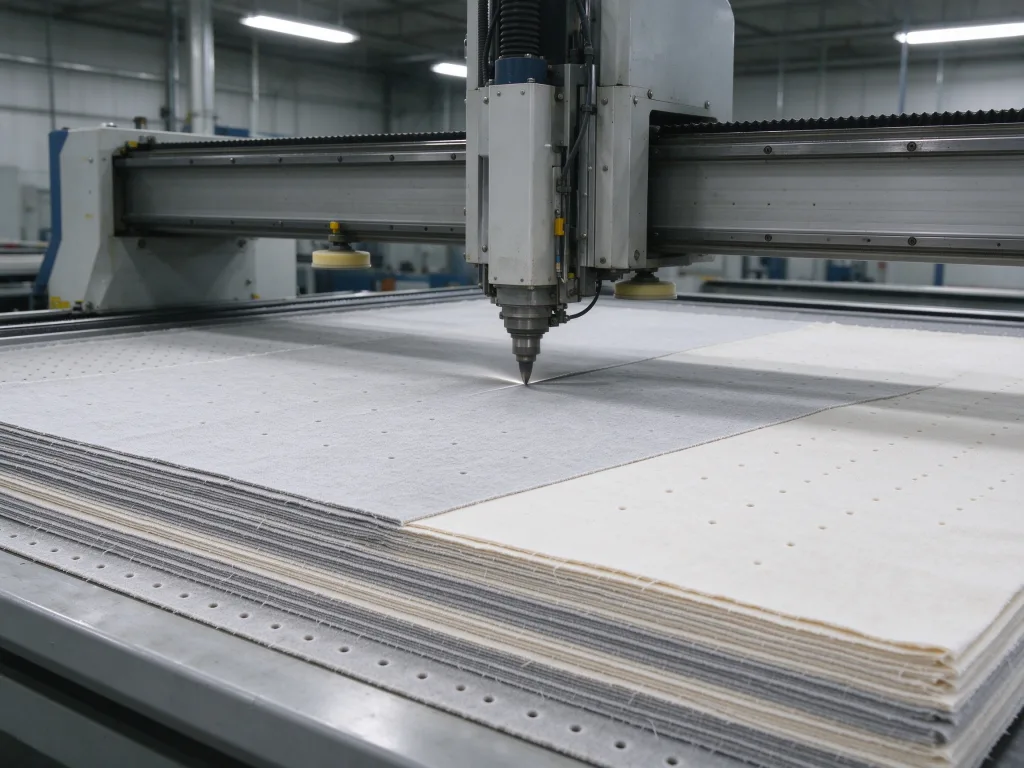
So How Do You Choose? Look at What You Cut Most
If you mainly cut polyester and nylon, and your patterns are complex, buy a laser. If you mainly cut cotton, linen, home textiles, or automotive interiors, with large orders requiring multi-layer cutting, buy an oscillating knife. If you do both, buy both. Laser handles sampling and fine cutting. Oscillating knife handles bulk cutting. I know several large factories with both in the workshop, each doing its own job. Neither steals the other’s work.
Do the Math: Don’t Just Look at Machine Price
The laser machine itself may be cheaper than an oscillating knife. But add the fume extraction system and filter replacement costs. A decent extractor costs a few thousand dollars. Filters need changing every few months. That adds up. The oscillating knife does not need fume extraction, but blades wear out. Cotton is gentle on blades. Coated fabric wears them faster. Factor in blade costs.
Overall, for high volume, oscillating knife has lower cost per piece. For fine work, laser is more economical. Where environmental regulations are strict, oscillating knife is easier. But if you need sealed edges on synthetics, laser is unavoidable.
Frequently Asked Questions
Can a laser really not cut pure cotton?
It can, but the edge burns. Unless you do not care about appearance. For pure cotton, oscillating knife is more reliable.
Does an oscillating knife fray polyester?
Yes. Synthetic fiber edges tend to fray and need serging. If you want to skip that step, use laser.
How thick can an oscillating knife cut?
After vacuum hold, generally 8mm or more. Some machines can cut up to 5cm.
Conclusion
There is no universal machine. Laser and oscillating knife each have their territory. First figure out what fabric you cut most. Then decide which machine to buy. Don’t let a salesperson dazzle you. What fits you is the best.
Related reading: CO2 Fabric Laser Cutter 80W-150W for Garment Printing · Can a CO2 Laser Cutting Machine Cut PVC Materials? · What Materials Can a CO2 Laser Cutting Machine Cut?
Not sure which machine fits the fabric you cut? Send us your fabric and pattern details and we will tell you which machine makes sense for your production.