
Manufacturers in garment accessories, luggage, sportswear, and flag production often ask: Can polyester fabric actually be cut with a CO2 laser?
In most cases, yes. In fact, polyester is one of the most ideal materials for CO2 laser cutting.
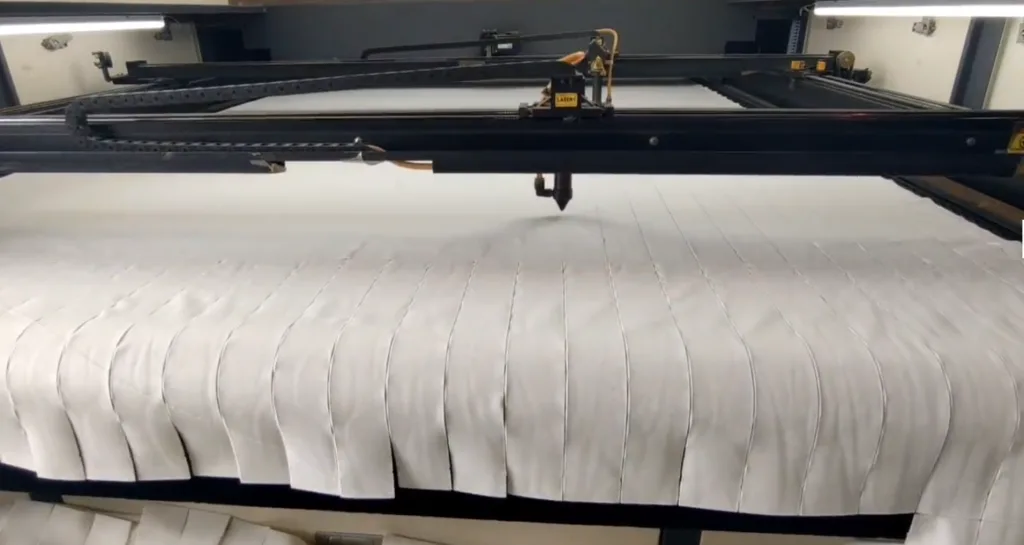
Polyester is a thermoplastic synthetic fiber. When the high-energy laser beam sweeps across the fabric, the fibers instantly melt. As the beam moves away, the molten material rapidly cools and solidifies. This process creates a heat-sealed edge that generally resists fraying and unraveling. Traditional die cutting and mechanical cutting normally do not create the same heat-sealed edge.
However, there is a prerequisite: parameters must be matched correctly. If the heat is not controlled properly—such as excessive power or slow cutting speeds—resin vapor from the melted fabric will re-condense on both sides of the kerf, leaving an ugly yellow scorch mark on light-colored fabrics. To achieve a clean, white, and beautiful cut on polyester, you need to understand its thermal behavior.
Why is Polyester the “Perfect Match” for CO2 Lasers?
The wavelength of a CO2 laser is 10.6 microns. The photon energy at this wavelength is highly absorbed by synthetic fibers.
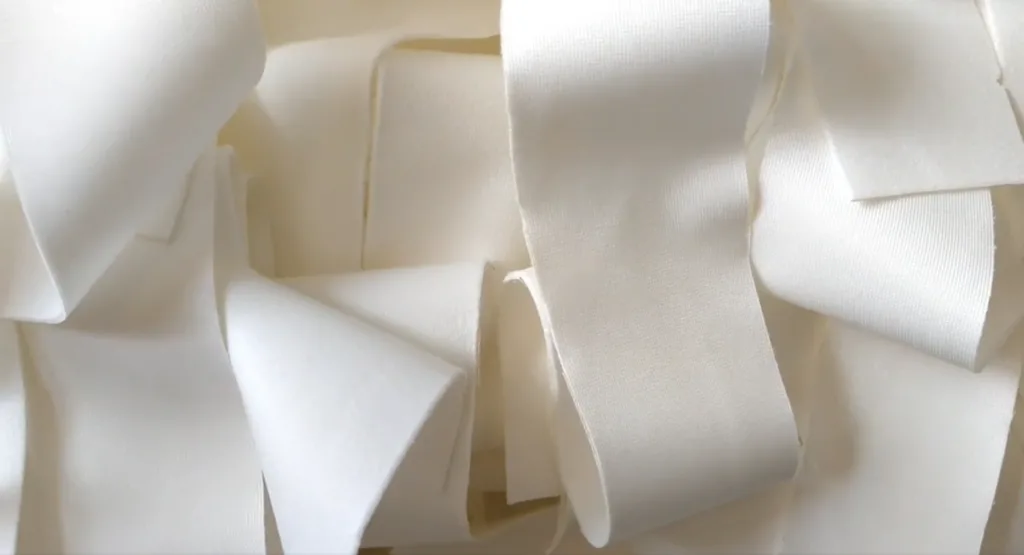
When the laser beam hits the polyester, the fibers instantly vaporize or melt. The molten material at the edge of the cut rapidly cools and solidifies in the ambient air. This is essentially an automatic heat-sealing process that locks the fiber ends tightly. The sealed edge generally resists fraying, although wash and abrasion performance depends on the fabric, edge geometry and processing conditions.
This is why manufacturers of sportswear, non-woven fabrics, and luggage linings prefer laser cutting—it eliminates the downstream need for serging or overlocking. Once cut, the fabric goes straight to sewing, multiplying efficiency.
How to Achieve a Perfect “Fray-Free, Non-Yellowing” Edge
While polyester is highly suitable for laser cutting, in actual operation—especially when cutting white or light-colored polyester—the edges will yellow if the parameters are wrong. The root cause of yellowing is heat accumulation causing thermal discoloration, or resin vapor failing to be blown away, resulting in secondary condensation.
To reduce yellowing and obtain a cleaner edge, start with the following settings. Treat them as a starting point and validate them on the actual machine and fabric:
1. Power and Speed: Start with Lower Power and Higher Speed
You don’t need full power to “burn” polyester. Excessive power or too slow a speed will cause heat to spread to both sides.
-
Recommended values: For a 40W-60W laser, the power for cutting thin polyester should be set between 20% and 35%. Maximize the speed. Let the laser sweep quickly to achieve an instant melt-cut, leaving no time for heat to spread.
2. Frequency: Use High Frequency to “Distribute” Energy
Low-frequency laser pulses have high peak energy, which easily causes localized overheating and charring. For synthetic fabrics, use high frequency (5000-8000Hz). This makes the pulses denser and lowers the energy per pulse, distributing heat more evenly and resulting in a smoother cut edge.
3. Assist Gas: High-Pressure Cold Air is Key to Preventing Yellowing
Using high-pressure assist gas (compressed air) is mandatory when cutting polyester. The dual function of the airflow is to blow away dross and resin vapor to prevent secondary condensation, and force-cool the cut edge.
-
Recommended values: Keep the air pressure at 0.3-0.6 MPa, with the nozzle 1-3mm away from the fabric. Ensure the airflow is aimed exactly at the center of the laser spot. If preventing yellowing on white fabric is critical, you can switch to nitrogen gas, which reduces oxidation and can help limit edge discoloration. Follow the machine manufacturer’s gas-safety and ventilation requirements.
4. Focus and Lens: Common Equipment Issues
Polyester has a shallow depth of focus, so the focus must land precisely on the material surface. More importantly, lens cleanliness is critical. If the lens is contaminated, laser energy attenuates. The operator is then forced to increase power to compensate, which leads to yellowed edges. Wiping the protective lens daily is a prerequisite for consistent cut quality.
Machine Selection: Matching Power and Feeding Systems
To cut polyester, you must choose a CO2 laser source. Fiber lasers cannot effectively cut synthetic fabrics.
Power Selection: For single-layer thin polyester (0.5-1.0mm), a 60W to 80W CO2 laser is more than sufficient and can achieve very high speeds. If you are cutting multiple stacked layers or thicker polyester canvas, go for 100W to 150W. RF (Radio Frequency) metal tube lasers produce a finer beam and superior cut edge compared to glass tubes, making them ideal for high-end brand orders with strict edge requirements.
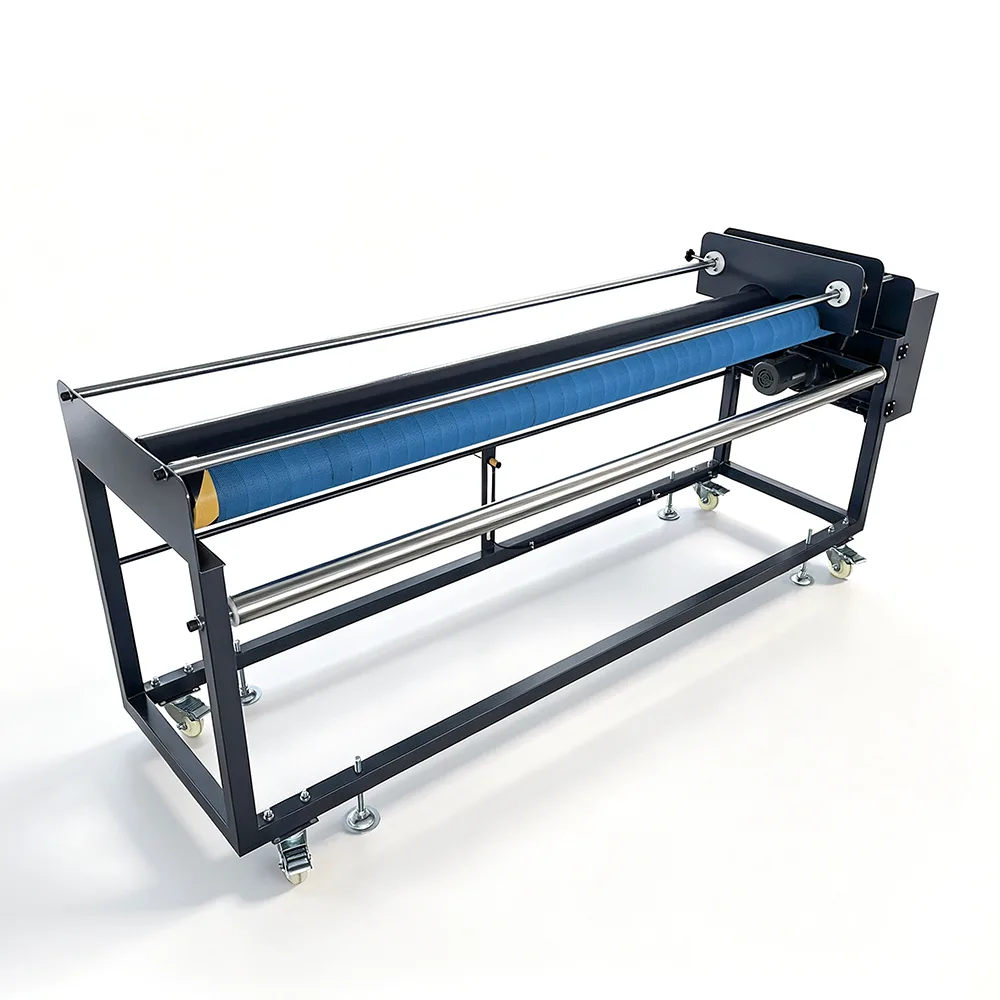
Feeding Method: Polyester is usually supplied in rolls. For high-volume continuous production, choose a machine with roll-to-roll auto-feeding or conveyor feeding. Paired with a CCD vision positioning system, it enables continuous cutting, which can reduce manual handling and support more continuous production. Actual output should be confirmed with a cutting test.
Fume Extraction: Melting polyester produces a significant amount of smoke. Strong extraction not only protects operator health but also prevents smoke and dust from contaminating the lens, maintaining stable laser energy.
Frequently Asked Questions
Is it normal for the edge of polyester to have hard melted beads after cutting?
A slight heat-sealed edge is normal and is exactly the advantage of laser cutting synthetics. However, if the beads are too thick or hard, it means the power is too high or the speed is too slow, causing molten material to accumulate. Slightly reduce the power, increase the speed, and ensure the assist gas is blowing away the excess dross.
Can multiple layers of polyester fabric be cut together?
Yes, but pay attention to heat conduction. When stacking multiple layers, heat dissipation between the top and bottom layers is uneven, which can easily cause the bottom layers to stick together at the edges. If you must cut multiple layers, lower the single-layer power, increase the speed, and ensure the assist gas penetrates every layer. It is highly recommended to run a test sample first to confirm layer separation.
What should I do if I smell a pungent odor when cutting polyester?
Melting polyester produces volatile gases, so a powerful fume extraction system is mandatory. If the odor is obvious, it means the exhaust volume is insufficient or the duct is blocked. Stop the machine immediately and check the exhaust and filters to protect the workshop environment and personnel health.
Conclusion
Polyester is exceptionally well-suited for CO2 laser cutting, and its inherent heat-sealing property is an advantage unmatched by other cutting methods. To achieve a clean, white, fray-free edge, the core strategy is to control heat, prevent discoloration, and remove dross promptly. Keep power low, speed high, and frequency elevated, paired with high-pressure cold air and strong extraction. When buying a machine, ensure it has a CO2 laser source and equip it with roll-to-roll feeding. Before mass production, run a step-parameter test with your actual fabric to find the sweet spot where it “just cuts through with a perfectly white edge.” Once this is validated on your own material, it can help improve cut consistency and customer confidence.
About the cutting photos and settings
The cutting photos in this article are from actual test cuts on polyester fabric. They show the working setup and the resulting cut edge under the tested conditions. The parameter ranges above are practical starting points, not a universal recipe: laser source, optics, focus, nozzle, air supply and fabric construction can all change the result.
This guide was reviewed for accuracy by the Dingfeng Laser Technical Team. Last reviewed: November 3, 2026.
Related reading
- How to choose an automatic fabric laser cutting machine
- CO2 laser cutting versus oscillating knife cutting
- CO2 laser cutter maintenance schedule
Have a polyester sample and a target output? Contact Dingfeng Laser to arrange a cutting test and machine recommendation.