
In the textile accessories, leather goods, automotive interiors, and handicraft industries, felt is an extremely common material. Felt is a non-woven material with no warp or weft threads; its strength comes from the physical entanglement of fibers. This non-woven structure gives it excellent warmth retention and cushioning properties, but it also brings trouble for traditional processing. When felt is die-cut, mechanical pressure compresses the soft edge, which can cause fraying, fiber pulling or even unraveling. For complex hollow patterns and dense perforations, custom dies are expensive and cannot guarantee consistent precision.
This is why an increasing number of manufacturers are turning to CO2 laser cutting machines. Laser cutting is a typical non-contact process. The focused high-energy beam instantly vaporizes the material without physical squeezing, cutting complex curves cleanly. However, operators new to the equipment often find the felt edge turns yellow, burns, or forms hard nodules. In Dingfeng’s 80-150W CO2 laser machine range, common synthetic, wool and blended felts can all be processed; the main variables are heat input and consistency of the material. Can a CO2 laser cutter achieve a clean, beautiful edge on felt? The answer is yes, provided you understand how it responds to heat.
How Felt Composition Affects Laser Cutting: Synthetic vs. Wool Felt
The result of laser cutting felt primarily depends on its fiber composition. Different materials have entirely different absorption rates and thermal reactions to the CO2 laser (wavelength 10.6 microns).
Synthetic Felt (Polyester/Nylon): The Perfect Match for Laser Processing.
Synthetic fibers are thermoplastic. When the laser’s high temperature sweeps across, the edge fibers instantly melt and solidify rapidly as the beam moves away. This acts as an automatic “heat-seal” on the cut edge. The resulting synthetic felt edge is normally smooth and sealed, and much less likely to shed or unravel. Many manufacturers making acoustic panels or packaging liners specifically utilize this laser melting characteristic to eliminate the need for secondary edge-sealing processes.
Wool and Natural Fiber Felt: Requires Extreme Parameter Tuning.
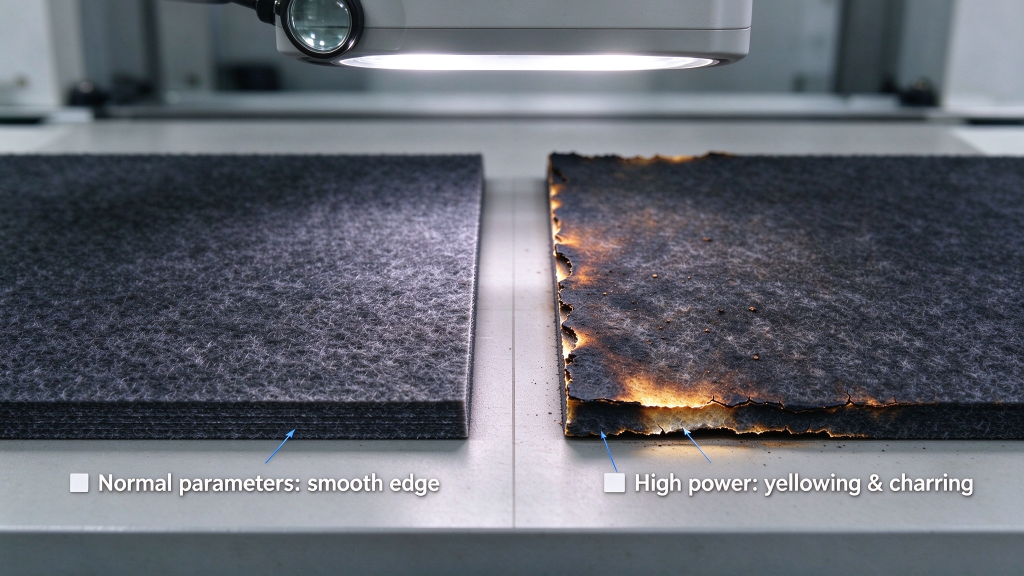
Wool is a natural protein fiber with no melting point. When the laser hits, it doesn’t melt and seal; it carbonizes directly. If the power is too high or the speed too slow, the edge will burn black, become brittle, and emit a strong burnt smell. Therefore, cutting wool felt requires an opposite strategy: “Extremely high speed, extremely low power.” The laser must slice through quickly, cutting the fibers instantly without giving them time to sustain combustion.
Blended Felt: Depends on the Synthetic Ratio.
In general, a higher polyester content tends to produce a more sealed edge. A 50% polyester blend can work well in many cases, but density, thickness, color and fiber construction can still change the result, so a sample test is essential.
Quick comparison of common felt types
| Felt type | Typical laser response | Cutting approach | Expected edge |
|---|---|---|---|
| Polyester / nylon felt | Thermoplastic; fibers melt and re-solidify | High speed with moderate power and strong air assist | Smooth, sealed edge |
| Wool or natural-fiber felt | Carbonizes instead of melting | High speed, lower heat input and excellent extraction | Clean but more matte; burnt odor must be controlled |
| Blended felt | Result depends on synthetic ratio and density | Start from the synthetic-felt setting, then test gradually | Usually sealed, but yellowing risk increases with wool content |
How to Achieve a Clean Edge: 4 Parameters You Must Nail Down
Felt is highly porous and contains a lot of air, resulting in poor thermal conductivity. If heat cannot dissipate, it accumulates at the cut edge, causing burning. To get a clean edge, you must control the following four dimensions:
1. Stick to the Golden Rule: “High Speed, Low Power.”
Do not copy the slow-speed, high-power parameters used for acrylic or wood. Start with a high cutting speed that still produces a stable cut, then reduce power until the beam cuts through cleanly without obvious dross on the back. Do not use a universal speed percentage for every felt; the sample and machine configuration determine the working window. This is your optimal parameter.
2. Precise Focus Position.
The more precise the focus, the smaller the spot size, and the higher the energy density. For felt, start with the focus at the material surface or only slightly below it. The best offset depends on the lens and nozzle setup. A narrower kerf means a smaller heat-affected zone.
3. Set the Air Assist Correctly.
Compressed air should be used when cutting felt; 0.3-0.5 MPa is a useful starting range, but the exact pressure depends on the nozzle and material. Felt cutting generates a lot of dust and molten synthetic fibers. High-pressure airflow instantly blows away the dross and smoke from the kerf, preventing secondary burning. Meanwhile, the cold air directly cools the cut edge—this is the most effective way to prevent yellowing.
4. Fume Extraction is Non-Negotiable.
Melting synthetic felt produces white smoke, and carbonizing wool produces pungent exhaust. Poor extraction not only affects health but, more critically, rapidly contaminates the laser lens. Once the lens is dirty, laser energy attenuates. The operator instinctively increases power, resulting in increasingly yellow edges.
How to Choose the Machine? Matching Laser Source & Configuration
To cut felt, you must choose a CO2 laser source. Felt fibers have extremely high absorption of the 10.6-micron wavelength; if using a fiber laser (1.06 microns), the beam will simply pass through without cutting.
How to determine power?
Most felt thicknesses range from 1mm to 10mm. The photographed test used an 80W CO2 laser source on ordinary uncoated felt. Dingfeng offers 80W-150W configurations; higher power can provide more headroom for thick felt or stacked layers, but it must be paired with a suitable cutting speed and air assist to avoid yellowing or a dark edge.
Dingfeng’s 80-150W CO2 configuration can move the laser head at up to 60 m/min. This is the maximum rapid traverse and positioning speed, not a guaranteed cutting speed. During cutting, the controller reduces the speed to suit the felt type, thickness, pattern detail and required edge quality.
Multi-head configurations can process several identical felt pieces at the same time. More cutting heads improve total throughput and the number of parts completed per cycle; the achievable linear cutting speed for each head still depends on the material, thickness, pattern and power setting.
Glass Tube or RF Tube?
If you are making high-end crafts or garment accessories that require maximum edge smoothness, choose an RF (Radio Frequency) CO2 laser. It produces a finer beam and more uniform energy distribution, resulting in minimal carbonization. If budget is limited, a standard glass tube also works, though the parameter window is narrower.
How to choose the feeding method?
If you handle sheet-cut pieces, a standard flatbed CO2 laser cutter is sufficient. If you process rolls of felt (dozens or hundreds of meters daily), strongly consider a machine with roll-to-roll auto-feeding or conveyor feeding. Paired with a CCD vision positioning system, the machine can recognize printed patterns and cut them without manual alignment.
Dust Extraction & Filtration.
When buying the machine, you must include an industrial-grade fume extractor or baghouse dust collector. It is a “life-saving” configuration for protecting the machine.
Frequently Asked Questions
Is there a fire risk when laser cutting felt?
There is a risk, but it’s controllable. Stick to “high speed + low power” and ensure maximum extraction. The heat at the cut edge is instantly blown away and cooled, preventing ignition. Never use extremely slow speeds paired with high power to “bake” the felt.
How do I handle yellow edges on thick wool felt no matter how I adjust?
Try the “multi-pass cutting” method: drop the power to 40% of the original, increase the speed, and cut halfway through on the first pass; then trace the same path for a second pass. Slicing it with high frequency and low heat will result in much less carbonization than burning through it with high power in one pass.
What should I do if hard nodules form on the edge of synthetic felt?
This is molten material buildup caused by excessive heat. Lower the power slightly and increase the speed. Also, check that your air nozzle is pointed exactly at the contact point between the laser and felt to blow away the dross in time.
Dingfeng Felt Cutting Test Notes
| Test item | Details |
|---|---|
| Test timing | Around October 20, 2026 |
| Machine type | Dingfeng CO2 laser cutting machine |
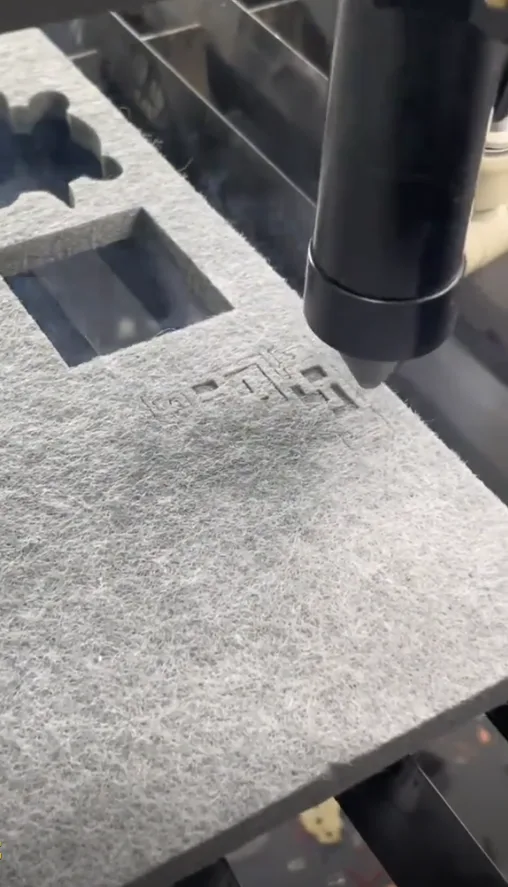
| Laser power used in the photographed test | 80W |
| Test head configuration | Single-head setup |
| Available machine power range | 80W-150W |
| Maximum laser-head traverse speed | Up to 60 m/min for rapid positioning and travel |
| Test material | Ordinary uncoated felt, approximately 3-4 mm thick |
| Multi-head production option | Multiple heads can process several identical pieces at the same time and increase total throughput. Multi-head operation was not used in the photographed single-head test. |
| Edge assessment | Clean and uniform when power is controlled; excessive power can cause yellowing or darkening |
The photographs in this guide show an in-house felt cutting trial carried out around October 20, 2026 on approximately 3-4 mm thick ordinary uncoated felt. The test used an 80W single-head configuration. The photographs are not generic stock illustrations. The cut edge was clean and uniform when the power level was matched to the material. Excessive power can produce slight yellowing or a darker edge, which is why sample testing remains important. Because felt density and fiber blend vary between batches, the tested setting should be treated as a practical starting point rather than a universal recipe.
Before You Cut: Sample Test Checklist
Felt is available in many densities, thicknesses and fiber blends, so a successful test on one roll does not guarantee the same result on another batch. Before placing a machine order, prepare a representative sample and confirm the following points with the supplier.
- Material composition: polyester, wool, viscose or a blend, including the approximate synthetic percentage.
- Thickness and density, measured on the actual production material rather than a sample swatch.
- Required edge: sealed and smooth, soft and unsealed, or suitable for later stitching.
- Cutting detail: minimum hole size, corner radius and the narrowest bridge in the pattern.
- Production method: single sheet, stacked layers or continuous roll feeding.
- Extraction and cooling setup, because smoke, dust and heat accumulation strongly affect edge color.
If the final product requires a soft edge with no melted fibers, compare the CO2 laser result with an oscillating knife cutting machine. The right choice depends on edge appearance, material composition and daily output, not on the cutting method alone.
Felt Materials That Are Not Suitable for CO2 Laser Cutting
CO2 laser cutting is suitable for ordinary uncoated felt, but it is not appropriate for every felt product. Avoid PVC-coated or PVC-backed felt because laser processing can generate toxic and corrosive fumes. Felt containing metal fibers is also unsuitable for a CO2 laser. For these materials, use an oscillating knife cutting machine instead, provided the material and final application suit blade cutting. If the composition is unknown, check the material safety data sheet (SDS) before processing.
Review note: This guide was prepared and reviewed by the Dingfeng Laser Technical Team using an in-house single-head 80W felt cutting trial carried out around October 20, 2026 on approximately 3-4 mm thick ordinary uncoated felt, together with Dingfeng’s 80W-150W CO2 machine configuration experience. Final power, speed, multi-head layout and air-assist settings should always be verified on the customer’s production sample.
Conclusion
A CO2 laser cutter can certainly cut felt, and it is the most efficient solution for processing complex felt products. The key to a clean cut lies in: Identifying the material and controlling the heat. Synthetic felt uses its thermoplastic nature to seal the edge perfectly smooth; wool felt requires high speed, low power, and strong air assist to avoid carbonization. When choosing a machine, stick to a CO2 laser source and equip it with a suitable feeding system and dust extraction. Before buying, bring your felt samples to the supplier for an on-site test, check the edge quality and cutting speed, and base your purchase on actual results.
About the Dingfeng Laser Technical Team
The Dingfeng Laser Technical Team supports machine selection, material sample testing, production setup, installation and after-sales service for CO2 laser cutting equipment. This article is based on the team’s single-head 80W felt cutting trial carried out around October 20, 2026 on approximately 3-4 mm thick uncoated felt, and its experience configuring Dingfeng 80W-150W CO2 laser systems for textile applications.