
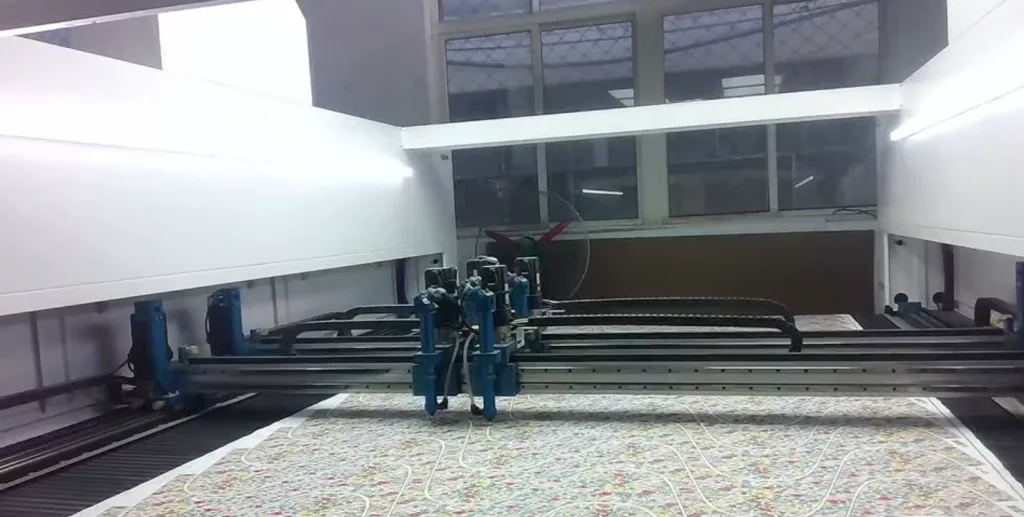
What an Automatic Feeding Laser Cutting Machine Does for Rolled Fabric
An automatic feeding laser cutting machine for rolled fabric is a CO₂ laser system that unwinds textile rolls under constant tension, advances the material continuously through the cutting zone, and cuts patterns while the roll feeds — rather than cutting one flat panel at a time. The practical result is continuous production from a single roll: synthetic fabrics come out with sealed, non-fraying edges, and the machine runs unattended through pattern sequences that would otherwise require an operator to reposition material after every cut.
The first decision variable is not laser wattage. It is whether the feed system holds the fabric edge stable across the full roll length. A machine that cuts accurately for the first two meters but drifts by ten millimeters at twenty meters will scrap more material than a lower-power machine with a stable feed. Everything else in the specification follows from that constraint.
How Automatic Roll Feeding Works: Closed-Loop Edge Correction vs. Manual Alignment
Closed-loop edge correction is what separates production-grade roll feeding from a basic motorized unwind stand. On the systems we configure, fabric-edge position is monitored continuously, with high-speed units sampling at up to roughly 50 times per second and steering the unwind or roller to keep the material centered. A validated setup can hold edge position within about ±0.5 mm across a continuous roll run, substantially reducing cumulative drift and making multi-meter cutting practical.
Manual alignment cannot reproduce this. An operator who centers the fabric at the start of a roll has no mechanism to correct cumulative drift as the roll diameter shrinks and tension changes. On a 50-meter roll, a 3mm lateral error at the unwind becomes a 10mm or larger pattern offset downstream. For any order that involves long continuous cuts or printed registration, closed-loop correction should be written into the purchase specification as a measurable requirement, not accepted as a feature claim.
CO₂ Laser Power Selection for Rolled Fabric: 60W–150W by Material and Layer Count
Single-layer garment fabric cuts cleanly at 60W to 150W. The machine achieves throughput through feed speed and cut-path optimization, not through raw power. This is the opposite of metal cutting logic, and it is where first-time buyers overspend and underperform: a 300W source running slowly on 0.3mm polyester produces an enlarged heat-affected zone, melted edge beads, and a cut quality worse than a 100W source running at matched speed.
Power should be specified from the material test, not from a tolerance for uncertainty. The escalation points are concrete: multi-layer stack cutting, heavy industrial canvas, and thick coated technical textiles move the requirement above 100W; standard apparel, swimwear, sportswear, and soft signage stay well below. A supplier who quotes power before seeing your fabric is quoting a guess.
Polyester vs. Cotton vs. Coated Fabric: Edge-Seal, Charring, and Fume Extraction
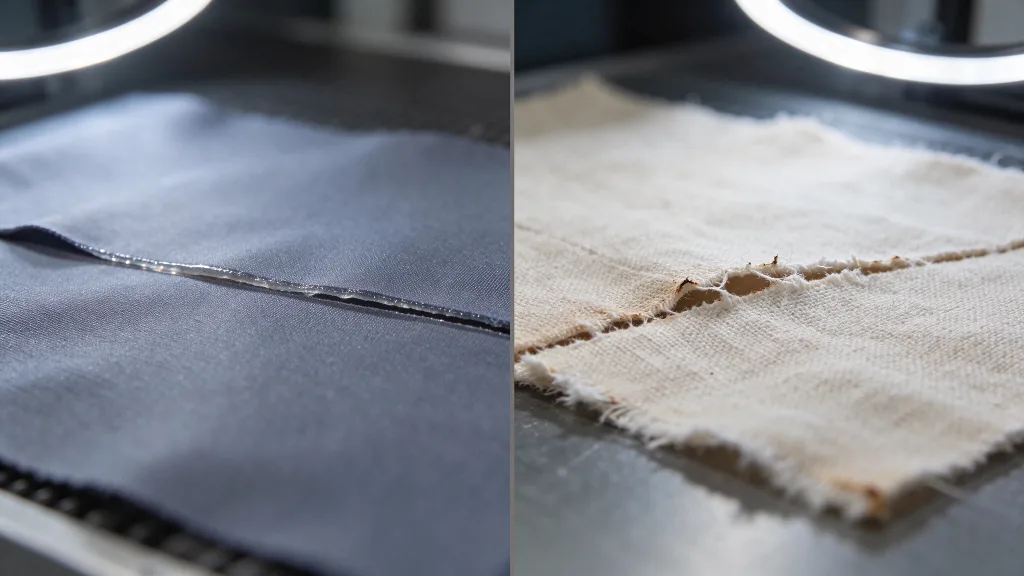
Polyester, nylon, and their blends melt and reseal at the cut edge. The cut is clean, requires no overlock, and does not fray — this is the core economic advantage of laser over blade cutting, and it is why sportswear, swimwear, outdoor equipment, and soft signage are natural laser applications. For material-specific settings, see our guide to CO₂ laser cutting for polyester fabric.
Cotton, linen, and wool do not melt; they carbonize. Light-colored cotton shows a tan to brown edge discoloration after cutting. Lower power and higher speed reduce it to near-invisible, but do not eliminate it. If the cut edge is enclosed in a fold-and-sew seam, the discoloration is irrelevant; if the edge is exposed in the finished product, natural-fiber jobs need evaluation before commitment.
Coated and laminated fabrics require separate testing and separate extraction engineering. PVC laminates release hydrogen chloride during laser cutting, and coated textiles generate complex fume profiles. These materials must not run on a machine without a matched extraction and filtration system, and should not be cut until the coating composition is confirmed.
CCD Vision for Printed Rolled Fabric: Registration Accuracy and Waste Reduction
CCD vision is optional for solid-color production and strongly recommended for printed, striped, or placement-print cutting. Manual registration requires repeated operator alignment, and its consistency falls as patterns become more complex or shifts lengthen. On a properly configured system, CCD cameras scan the full fabric width, identify registration marks and pattern edges, and adjust the cut path in real time for stretch, skew, and print shift. Under stable lighting and clearly printed marks, this produces much more consistent registration than manual alignment across a long production run. Final accuracy should still be verified with the customer’s printed roll and production file.
For a factory with sufficient order volume, lower registration waste and faster repeatable setup can recover the vision system’s incremental cost quickly. Payback varies with machine utilization, fabric value, local labor costs, and current rejection rates, so each market should calculate it from its own production data. Evaluate the system on real-time compensation during lateral drift and longitudinal stretch, and on whether it can re-nest automatically when a defect is detected.
Unwind Frame Load Capacity, Core Handling, and Pre-Feed Distance
Unwind frame engineering determines daily operating cost in ways the spec sheet rarely states. A standard unwind requires the operator to lift the roll onto a mandrel; wide or heavy-gauge rolls typically need two people. A tilt-hopper frame lowers to near floor level so one operator can load a roll without lifting, and eliminates the paper core — a frequent cause of unplanned downtime when cores collapse during roll changes.
Load capacity must match actual roll weights. Standard unwind handles rolls under 50kg; industrial textiles, automotive interior fabric, and thick coated materials frequently exceed 100kg per roll, and the frame must be rated accordingly. Pre-feed distance is the other hidden cost: some systems run a long leader of fabric before cutting stabilizes, and that leader becomes scrap. Optimized designs cut pre-feed to roughly 10cm, which on expensive technical fabric accumulates into a meaningful annual saving.
Pre-Purchase Fabric Sample Test: What to Request and What to Measure
What to send before a quotation
Send at least three meters of continuous fabric from the actual production roll, marked for warp direction, with the cut file you intend to run and your target daily output. Require edge micrographs from the cut sample and a registration accuracy log across a continuous 20-meter run. If the job involves print, include the original design file and the actual printed fabric so the vision system runs the registration sequence under real conditions.
What the test report should prove
Reject generic “standard fabric parameters” as a basis for the decision. Knit and woven fabric of the same nominal composition, and the same fabric after different finishing processes, behave differently under the laser. A supplier who tells you to test first, set power second, and discuss price third is describing the correct sequence. Send a 3-meter production roll sample with cut file and target output — a qualified supplier returns edge micrographs and a 20-meter registration log before any contract is discussed.
Request a Fabric Sample-Cut Evaluation
Send three meters of the actual production fabric together with your processing width, layer count, printed artwork, and target daily output. Our engineers can review the appropriate automatic feeding laser cutting machine configuration against your material and production requirements.
Contact Dingfeng to request a sample-cut evaluation and quotation before committing to laser power, working width, or unwind-frame capacity.
Bottom Line: Specify the Feed System Before Laser Power
The value of an automatic feeding laser cutting machine for rolled fabric comes from feed stability, registration accuracy, and fabric compatibility working together. Budget for the feed system and the material test before focusing on wattage or bed size. With sufficient order volume, reliable feeding and rapid vision registration can reduce labor and waste and shorten payback, while the actual return still depends on local wages, material costs, utilization, and quality requirements.